Posture Matters

Posture check! Are you hunching over your screen or keyboard right now? When you bend your head, like when you use your phone, your neck muscles are working to hold the weight of your head. All of this extra stress on your neck and shoulders can cause headaches, back and neck pain and a permanent curve of your spine such as a hunch.

Another surprising link to bad posture is acid reflux! When you sit hunched over you constrict the flow of digestive juices through your digestive system. This can cause the acids in your gut to be pushed back up, causing that feeling of acid reflux and indigestion.

Studies have shown that good posture has an affect on the mind as well as the body. When you walk into job interview with your head up and your back straight you not only give a good impression on the people around you but you also feel more powerful. Compare this with a shy stance, shoulders rounded and face pointed towards the ground – this gives the impression of a lack of confidence.

While the emotional effects of good posture are important, maybe you’re looking to improve your physical health when performing day to day tasks.

When your neck muscles are straining to hold up your head and your shoulders are rounded over, that extra load on the muscles will cause them to fatigue. You’ll notice pain in your neck and shoulders after sitting at your work desk for hours without a break. Headaches become more common as these muscles are knotted and tensed up.

Note: No one really knows what the knots in our muscles are but they can be alleviated by stretching and massage.

The mayoclinic.org website has this handy advice for using your phone in an ergonomic way to prevent back and neck pain:

Avoid looking down at your phone

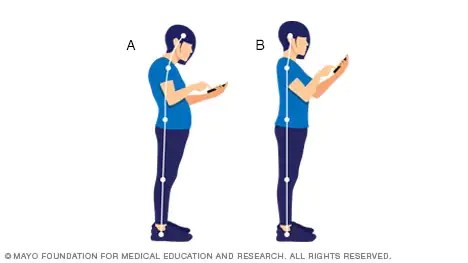
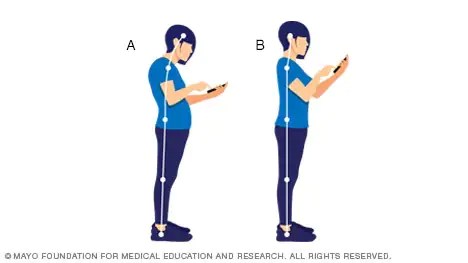
Looking down at a smartphone can cause you to flex your neck and strain your cervical spine (A). When standing and looking at your phone, maintain good posture and aim to hold your phone close to eye level (B). When sitting and looking at your phone, sit upright and use armrests — or alternatively a desk or pillow — to support your arms.
Source: mayoclinic.org

There are more ergonomic tips for sitting at a computer or desk. These include making sure your feet are flat on the ground and your spine has a natural arch, without the shoulders hunched forwards.

Source: mayoclinic.org

So remember to hold your chin up. Look the world in the eye. I hope this was interesting and useful information. Thanks for reading!

Visit http://www.youtube.com/queeenvk for more Full Cup Wellness health tips. For some silliness and little handy life tips my tiktok is queeenvk (don’t forget those 3 e’s).


The power of journaling

What is journaling?

The basic idea is that you record your thoughts, emotions and experiences. Normally this is done daily in a book. The act of writing things down encourages the information to be stored more effectively in your memory.

Why journal? Is it right for you?

Writing down your thoughts right before sleep can help to release your brain from the noise of the day. Or you might like to keep record of exciting or happy memories. For example, I have a memory that I wrote in 3 separate journals because it was so exciting at the time. At the age of 10 I watched a dog give birth to a litter of puppies. In my first 10 years of life that was the most amazing thing I had ever experienced and I needed to record it. Eventually my young mind started worrying I would forget my memories and made sure to journal all my family holidays and various events in my life. Now in my 30s I gladly live mindfully in the moment without fear of forgetting the past. We do not need to be attached to our past in a way that affects our mental health negatively.

Writing things down can help you to let some difficult emotions go. Once the thoughts and fears are set out on the page in front of you they don’t seem so big and overwhelming. And bonus, you don’t feel the pressure to keep the thoughts and memories in your head because they’re recorded for you already. That takes a lot of stress off your brain.

According to various articles from psychological research there are positive and negative outcomes to journaling. It can either help you understand yourself in relation to others or it can hinder your self discovery journey if you only concentrate on “yourself in isolation”. The results of a collection of research articles include the following positive and negative outcomes of journaling.

The pros of journaling

  • Encourages you to evaluate your reactions and emotions
    • Identify action vs reaction. Reaction is what we do with our “monkey brain” when we act on impulse without consideration.
  • Allows you to find resolutions to open issues
    • You can see all aspects of a problem when it’s written out in front of you.
  • Clarifies your views and motivations.
  • Focuses your negative energy into creativity and positivity.
  • Increases your tolerance of change and unpredictable or unexpected situations.
  • Improves mental health by making you feel more connected to the world around you.
  • Helps you define your goals and encourages action through motivation.

The cons of journaling

  • Causes negative rumination
    • You live within your own negative thoughts.
  • Prevents you from living in the moment
    • You begin to focus on how you’ll record your life events instead of experiencing them.
  • Makes you become egocentric and obsessed with your needs.
  • Allows you to blame the situations around you but not come to any positive conclusions.
  • Prevent resilience by encouraging thoughts to remain on negative experiences.

Maintaining the habit of journaling regularly can be a challenge. Although it becomes easy once it becomes part of your daily routine. Encourage yourself to keep at it by making it a fun and rewarding experience. Use different coloured pens and highlighters to really engage with your journal pages. I have an old sticker collection from my youth that I’m re-purposing in my journals, cards, labels and craft. Some are those holographic stickers from the 90s, they really jazz up a sparse journal page.

Thanks so much for reading! Comment below with your journal experiences. Or share your tips and hints to make the most of our journaling journey.

Subscribe to my YouTube channel to show your support for The Full Cup Wellness.